Home Stories About Contact Let's Talk

From Chaos to Systems

These aren't hypotheticals. These are systems I built that run in production every day—processing orders at scale, managing a team, and keeping a high-volume operation from falling apart.

Label Grabber Pick Lists & Show Mixes Admin Dashboard
Case Study 01

Label Grabber

Multi-platform shipping label automation that eliminated 4 hours of daily manual work.

chrome-extension://labelgrabber
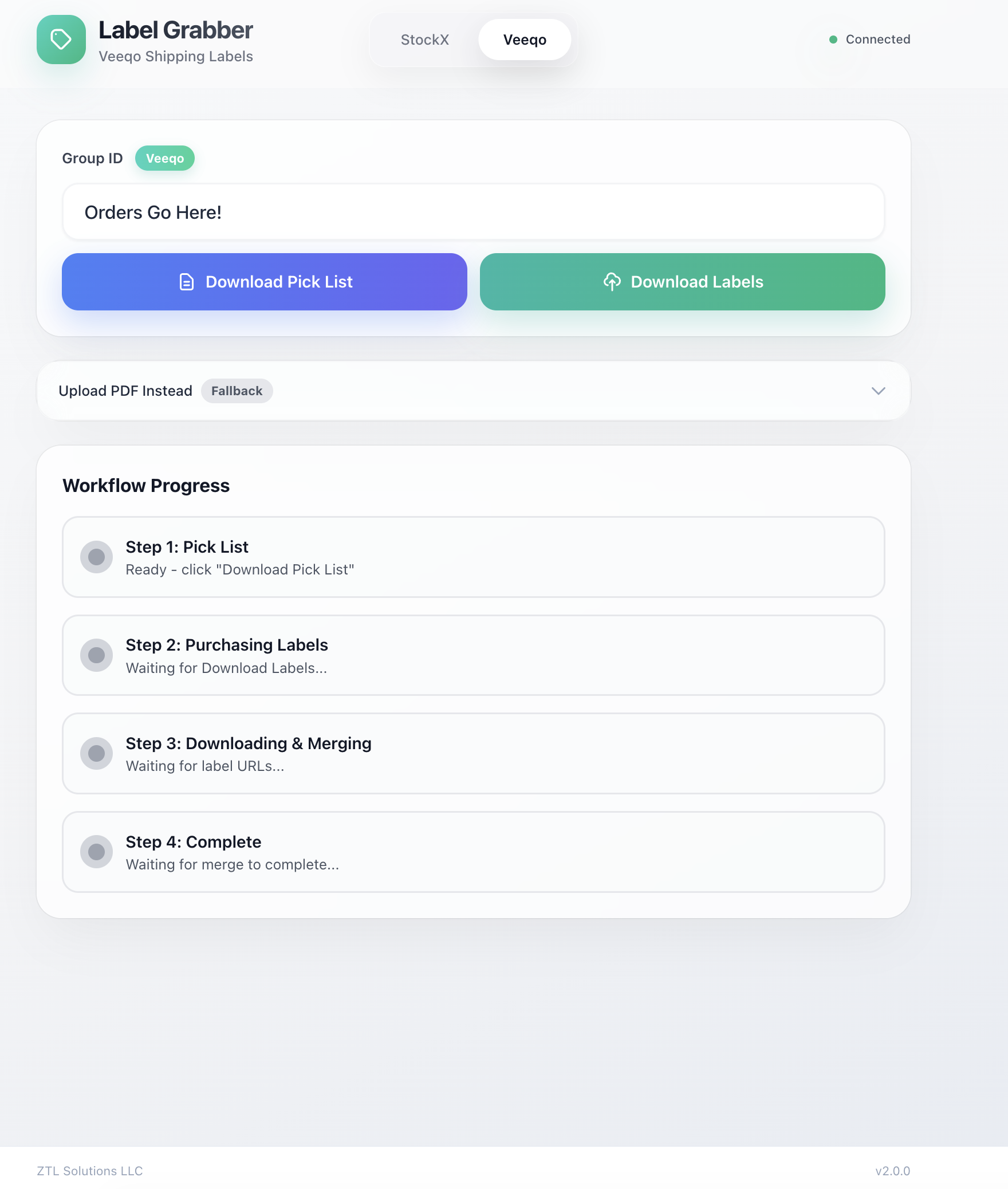
Label Grabber - Automated shipping label generation

The Problem

We sell across multiple platforms—StockX, Shopify, and Veeqo handles our inventory. Every single day, we ship hundreds of packages. Before Label Grabber, the process looked like this:

  1. Log into StockX. Find pending orders. Click into each one. Download the shipping label. Repeat 50+ times.
  2. Switch to Veeqo. Same thing. Another 50+ clicks.
  3. Now try to figure out which label goes with which product in the warehouse.
  4. Print them all separately. Walk around matching labels to items.
  5. Cross your fingers that nothing gets mixed up.

This wasn't just slow—it was dangerous. At our volume, one mislabeled package means an expensive product ships to the wrong customer. That's a chargeback, an angry buyer, and inventory we can't recover. We were bleeding time and money.

What I Built

I built a web app that connects directly to StockX and Veeqo's APIs and consolidates the entire fulfillment workflow into one interface.

Here's how it works:

  • One dashboard for all orders. The system pulls pending orders from every platform automatically. No more logging into three different sites.
  • Smart pick list generation. Click a button, get a pick list organized by warehouse location. The warehouse team knows exactly what to grab and where to find it.
  • Batch label download. Instead of downloading labels one by one, the system fetches all of them in parallel, merges them into a single PDF, and organizes them to match the pick list order.
  • Visual workflow tracking. A progress indicator shows exactly where you are: Pick List → Purchase Labels → Download → Complete. No guessing, no missed steps.

The warehouse team opens the app, selects the orders they're working on, prints the pick list, grabs the products, then prints the merged labels. Everything matches. Every time.

The Result

3-4 hours → 15 minutes. What used to eat up half a workday now happens during a coffee break.
Zero mislabeled packages since launch. The system makes it impossible to mix things up.
Warehouse runs independently. The team doesn't need someone in the office clicking buttons anymore.
Handles any volume. 50 orders or 500—same process, same speed.
JavaScript REST APIs StockX API Veeqo API PDF Generation Web App
Case Study 02

Pick Lists & Show Mixes

Intelligent inventory selection that makes live selling shows actually work.

The Problem

We run multiple live selling shows every week. Each show features dozens to hundreds of products. That means someone has to decide which items—out of thousands in inventory—should go on air. And they need to do it in a way that makes sense for both the audience and the warehouse team pulling the products.

Before the system, show prep looked like this:

  1. Open a massive spreadsheet with thousands of SKUs. Scroll. Scroll more.
  2. "What sizes do we have in this?" Check another tab. Check the warehouse. Still not sure.
  3. Pick items based on gut feeling—no data on what actually sells.
  4. Type up a pick list by hand. Hope you spelled the bin locations right.
  5. Warehouse team walks back and forth across the floor because items are scattered everywhere.
  6. Mid-show: "Sorry, we don't have that in your size." Customer leaves.

Shows felt random. Some performed well, others tanked—and nobody could explain why. The team was spending 2+ hours prepping each show, and still walking into streams without confidence in what they were selling.

What I Built

I built an intelligent pick list generator that takes the guesswork out of show prep. It connects directly to our inventory system and applies logic I developed based on months of sales data:

  • Size intelligence ("BAE" logic). The system knows which sizes actually sell. Smalls and mediums move fast—XXL sits for months. It prioritizes inventory that will actually convert during a show.
  • Anti-clustering algorithm. It won't put five Nike hoodies in a row. The mix is automatically varied—different brands, styles, and price points spread throughout the show to keep viewers engaged.
  • Real-time inventory sync. Every pick list reflects what's actually in stock right now. If something sold on Shopify ten minutes ago, it's already excluded.
  • Warehouse-optimized routes. Items are sorted by bin location so the warehouse team picks in a logical path instead of zigzagging across the floor.
  • Allocated item exclusion. If an item is already promised to a pending order, it won't appear in a show mix. No more double-selling.

You tell it how many items you want and what vibe you're going for. It spits out a curated mix with every size breakdown, bin location, and historical performance note you need.

The Result

2 hours → 20 minutes. Show prep that used to drain an entire morning now happens before the first coffee is cold.
40% fewer "out of stock" moments during live streams. We stopped disappointing customers mid-purchase.
Route-optimized picks cut warehouse walking time by half. Less fatigue, faster pulls.
Higher show conversions because every mix is built on data, not gut feelings.
Google Apps Script JavaScript Inventory APIs Custom Algorithms Google Sheets
Case Study 03

Admin Dashboard & Streamer Portal

Two connected systems that turned team management from chaos into clarity.

admin.ztlsolutions.com
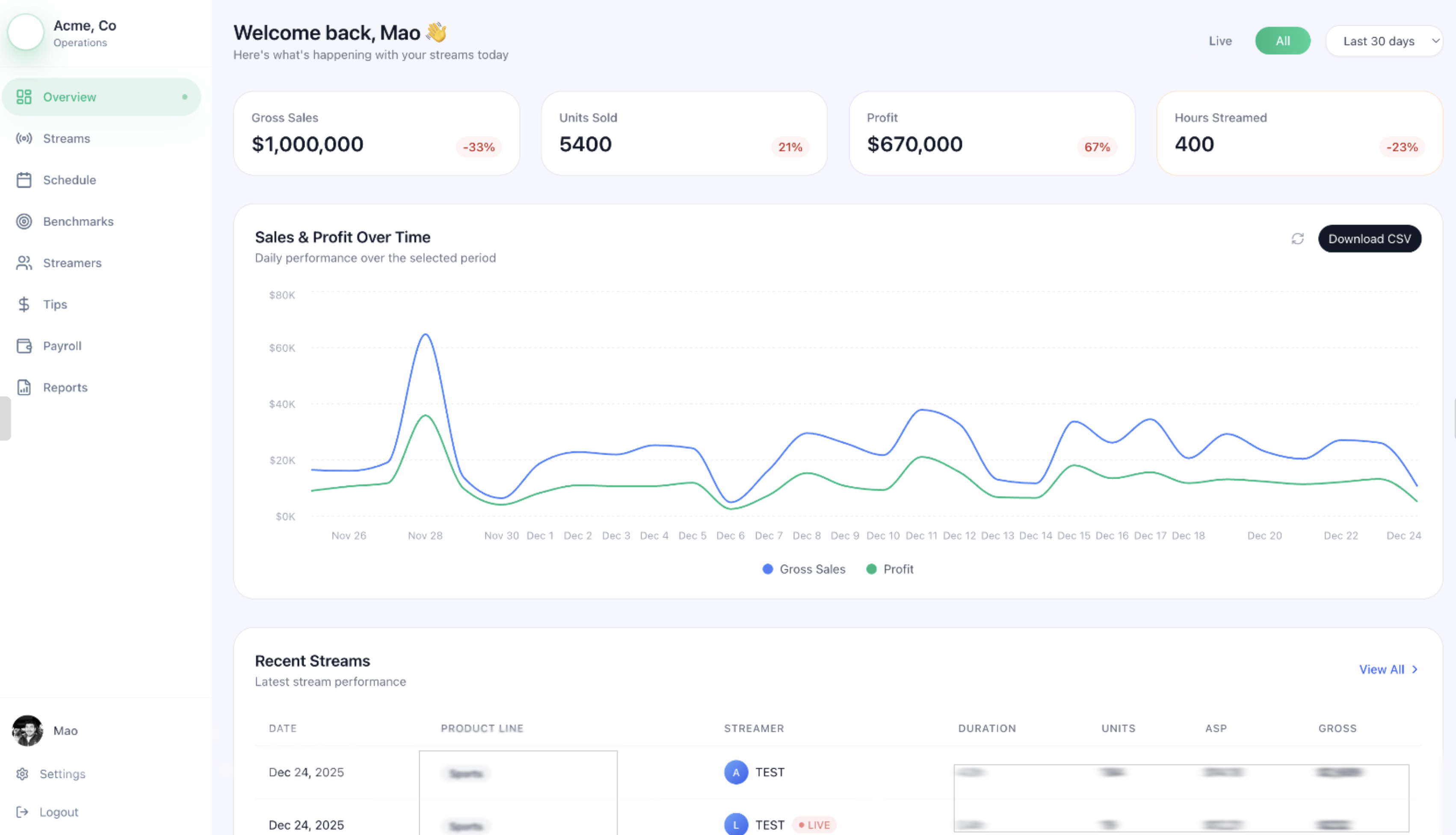
Admin Dashboard - Real-time operations management

The Problem

Managing a team of live selling streamers is harder than it sounds. We're not talking about a traditional sales team—these are performers who go live on camera, work variable hours, and earn based on complex commission structures that change constantly.

Before the system, the management layer was duct tape and spreadsheets:

  • Schedules lived in a Google Doc that nobody maintained. Double-bookings happened weekly.
  • Commission calculations took 4+ hours every pay period. Someone had to manually cross-reference sales data, hours worked, bonus tiers, and tips—then pray they didn't make a math error.
  • Performance was a mystery. We knew someone was selling, but who? How much? What's their units-per-hour? No idea.
  • Onboarding was chaos. Training docs in email, NDAs in DocuSign, schedules in Slack, payroll forms somewhere else. New hires were lost before day one.
  • Constant interruptions. "When do I work next week?" "How much did I make last show?" "Where's that document you sent me?" Management became a help desk.

Every week, someone on the management side spent half their time answering questions that should have been self-service. And every payroll cycle felt like defusing a bomb.

What I Built

I built two interconnected systems—one for management, one for the team—that share the same data but serve different purposes.

The Admin Dashboard is the command center for operations:

  • Real-time P&L breakdown. See profitability by streamer, by show, by platform—updated as sales happen.
  • Automated commission engine. Define the rules once (base rate + per-unit bonus + tier multipliers + incentives + tips), and the system calculates everything automatically. One click generates the payroll export.
  • Schedule management with conflict detection. Can't accidentally book two people for the same slot. The system catches it before you save.
  • Performance analytics. Units per hour, average sale value, conversion rate, show-over-show trends—all the metrics needed to coach the team.

The Streamer Portal is what the team sees:

  • Personal performance dashboard. Earnings, units sold, hours streamed—presented clearly with comparisons to their own history.
  • Schedule visibility. See upcoming shifts, submit availability, request changes—all in one place.
  • Document hub. Training materials, company policies, and everything they need to do their job, organized and searchable.
  • E-signatures built in. NDAs, non-competes, acknowledgments—signed electronically and stored automatically.
  • Leaderboard. Healthy competition with visibility into team performance (anonymized or not, depending on settings).

Both systems sync in real-time. When a sale happens, the streamer sees their stats update. When management adjusts a schedule, the streamer's calendar reflects it instantly.

The Result

Commission calculation: 4 hours → 10 minutes. What used to be a weekly headache became a button click.
Zero payroll errors since launch. No more "you underpaid me" conversations.
Self-service everything. Streamers stopped asking questions—they just check their portal.
Scheduling conflicts eliminated. The system won't let you make mistakes.
60% faster onboarding. New hires complete everything from one dashboard.
Data-driven coaching. Finally know who's crushing it and who needs support.
Supabase PostgreSQL JavaScript Real-time Sync Custom Auth PDF Generation E-Signatures

Got a similar mess?

These were real problems that needed real solutions. If your operation has similar chaos, let's talk about what I could build for you.

Let's Talk
Get in touch

Let's talk about your problem

Please enter your name
Please enter a valid email
Please describe what you need help with

Got it!

I'll get back to you within 24 hours. In the meantime, let's find a time to chat.